

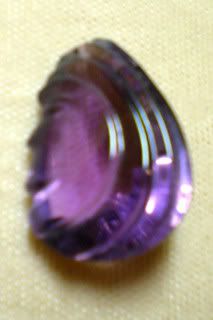
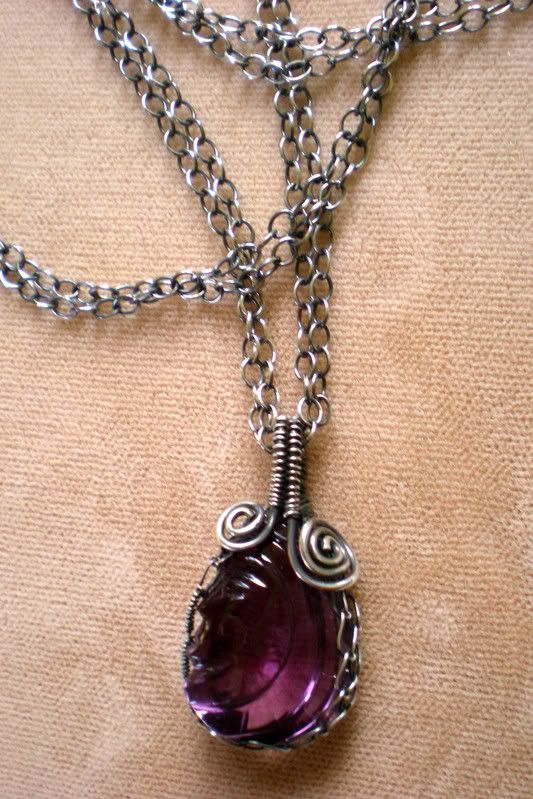
This necklace was a special commission for a friend. She had the teardrop shaped stone (amethyst, I am pretty sure) that was mounted in a very simple four-prong gold frame for a necklace. This is a piece with sentimental value to her, as it was given to her by her grandmother. But she wanted something original done with it, since it was a very standard (read boring) setting for the stone.
I took the stone out of its setting and it sat on my bench in my studio for a while (ok, a long while) as I worked on other things. Then one day as I was glancing at it, it occurred to me that the stone has a face profile carved into the side of it.
I thought that the Net Bezel Pendant design from Eni Oken (
www.enioken.com) would be the best way to work with the piece. I had already done one piece with this design and really liked the results. The only thing was that I did not want to cover the profile of the stone with the wire netting. So I really had to think about how I would resolve that design issue.
I finally decided that I would wrap the netting wire around the wire of row that sits flush with the edge of the pendant on the profile edge. This would serve two purposes: Make the transition to the next row and also create an asymmetrical effect that would help to draw attention to the profile. Then when I finished the pendant, I reinforced the asymmetrical nature further by coiling the bail detail at different levels. It also makes the setting more secure.
I consulted with my friend and she decided that she wanted a long (24”) necklace out of doubled sterling chain. This really accentuates the nice vintage look of the wire pendant work.
This project is a great example of how design challenges are great opportunities for design innovation.
 One of my last projects in 2010 was the creation of this necklace showcasing a crinoid fossil. The piece was a gift for a special friend, and it enabled me to practice a few more techniques that I just learned this year: Forming with sheet metal, utilizing riveted prongs to hold the piece to the metal, and soldering rings.
  The piece has a double bail that hangs from brown leather, with a hand forged clasp.
 The piece has a double bail that hangs from brown leather, with a hand forged clasp.



 Posts
Posts


